Showing posts with label art. Show all posts

Thursday, May 16, 2013

View of Delft - Johannes Vermeer


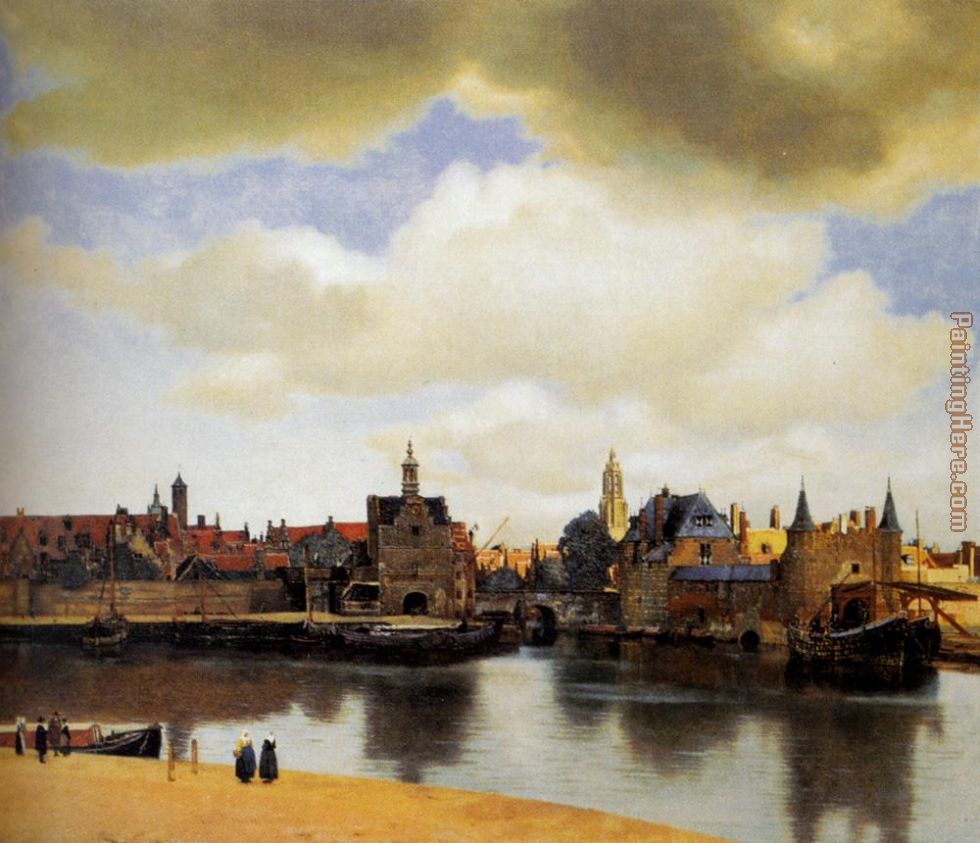
View of Delft is a painting by Dutch artist Johannes Vermeer. It is an oil on canvas and is 98 x 118 cm. It was started in 1660 and finished in 1661. The genre is landscape art, and in the time it was painted, cityscapes were not a popular subject for paintings. It is one of three of his paintings of Delft. The other two being The Little Street, and House Standing in Delft, which is lost.

When looking at this picture the eye is immediately draw to the cityscape, however after a longer period of time, one notices that the sky takes up more than half of the canvas. Clouds cover most of the blue, and at the very top is an ominous, looming thundercloud. At the bottom on the canvas there is more detail, and an even greater amount in the middle. In the bottom left hand corner is a group of people conversing. There is a woman and her child, a man talking to a couple, and two older women off to the side. They are all wearing traditional clothing. Just above them is the Schie Canal and several types of boats. These include a tow barge, sailing ships, tow barges, and herring busses.

The larger tower in the back to the right of the channel is the New Church. In the actual city of Delft, the New and Old Church are just as grand and assuming. However, in Vermeer's painting, the New Church is pictured nearly twice as wide and much more prominently. Furthermore, the bell tower appears to be empty. However, it has been proven that during the summer of 1660, the bells were taken for restoration. Some of the other buildings are the Rotterdam Gate, part of which are the twin towers in the picture, the Schiedam gate, the Armamentarium, and the Kethel gate.

Among art historians, there is a debate as to whether or not Vermeer used a camera obscura, the precursor to the modern photographic camera, to aid him in painting this cityscape. The lengthy depth and immaculate focus of all the details in the painting lead many to believe it would have been impossible to do with the naked eye. Others believe he used an inverted telescope to view the scene rather than a camera obscura.


Sources

http://en.wikipedia.org/wiki/View_of_Delft
http://kalden.home.xs4all.nl/verm/ship/Ships_main.html
http://kalden.home.xs4all.nl/verm/view/Vermeer_main.html
http://www.wga.hu/frames-e.html?/html/v/vermeer/02c/13view.html
http://www.artble.com/artists/johannes_vermeer/paintings/view_of_delft
http://www.learner.org/courses/globalart/work/177/index.html

Wednesday, May 15, 2013

Las Meninas - Diego Valazquez


Las Meninas (The Family of Felipe IV) is Spanish for The Maids of Honor. This painting was painted in 1656 by Diego Valazquez (1599-1660), a Spanish portrait artist during the Baroque period. The painting itself is oil on canvas and is a grand 318 x 276 cm. The painting was damaged during a fire in 1734. Parts of it were repainted including all of the Infanta's left cheek.

This painting is complex with detail and has been interpreted in many ways by many art critics. When one first views the painting, they can't help but notice the many paintings cluttering the walls and the numerous subjects in the room, which is a hall of Madrid's Alcazar Palace.

The main subject, Infanta Margarita, the five year old daughter of Felipe IV, is positioned near the center in a white dress. To either side of her are her meninas. Isabel de Velasco is in the middle of curtsying to the girl, and Maria Agustina Sarmiento de Sotomayor is kneeling, offering her a drink on a golden platter. The girl is accepting because her hand is placed on the red cup. Then off to the right are two juxtaposed dwarfs. I don't know if it was common practice for royalty to house midgets, but they definitely threw me off and made the mysterious painting even more enigmatic. Regardless, the larger female dwarf was a German named Maribarbola, and the smaller dwarf to the right is the Italian Nicolas Pertusato. He is nudging the dog with his foot, trying to rouse him. The two people further behind are the princess's chaperone, Marcela de Ulloa, and the princess's bodyguard whose name is unknown. Beyond the door frame is Don Jose Nieto Velazquez, the queen's chamberlain, posing on a staircase with his feet on different steps.

The last three subjects in the painting are where the different interpretations of the painting come in. To the left is a self portrait of Valazquez painting on a giant canvas. His magnificent moustache is flowing wildly on his face, he is holding paint brushes and a palette, and he has a red cross of the Order of Santiago across his chest. He added this cross to the painting at least three years later when he received it. On the back wall is a mirror. It is assumed to be a mirror because it looks more reflective than the other canvases on the wall. In the reflection is King Philip IV and Queen Mariana de Austria. The discrepancy is between what Valazquez is painting and what the viewers' perspective is. The first theory is that Valazquez is painting the King and Queen, and the mirror is reflecting that image back to the viewer, and therefore our perspective can be our own or the King and Queens. The other theory is that Valazquez is painting the painting we are viewing, and that we are viewing this scene from the perspective of the King and Queen, and our own image is being reflected back at us. There are also many other philosophical theories including different versions and combinations of the above theories. Some don't believe that the object on the back wall is a mirror, but another portrait.

Now that we've covered the subjects in the painting, we can move on to the paintings in the painting. The only two fairly clear paintings are the large two on the back wall. They are thought to be oil sketches by Peter Paul Rubens. The one on the left being Minerva Punishing Arachne and the one on the right being Apollo’s Victory over Marsyas.


The painting has been copied in many styles and versions by several artists. Most notably Pablo Picasso and Salvador Dali.


Sources
https://blogger.googleusercontent.com/img/b/R29vZ2xl/AVvXsEg0RZQqdcnqJOQB_czD1NbtQ4G_trKbzwZbUDpKNixgWF5hjDI-VhT8vCeL8V68xLTuENVqxVL_mYxKDelhlb1_qULw4PBLsrfu8YjNGPWNMxY7AvFwEhBaKG59nmOgKDw6XuKOCiTFzIQ/s1600/Velazquez-LasMeninas.gif
http://www.museodelprado.es/en/the-collection/online-gallery/on-line-gallery/obra/the-family-of-felipe-iv-or-las-meninas/on of atmosphere.]
http://stephaniekrills.wordpress.com/2011/02/25/47/
http://www.evl.uic.edu/chris/meninas/
http://secrethistoryofart.blogspot.com/2010/12/velazquez-las-meninas.html
http://simple.wikipedia.org/wiki/Las_Meninas
http://www.washingtonpost.com/wp-dyn/content/article/2010/12/23/AR2010122301932.html?sid=ST2010122301989
http://en.wikipedia.org/wiki/Las_Meninas

Tuesday, May 14, 2013

I am a math and science oriented person and I wanted to become more cultured by learning about and learning to appreciate art. Magnastra is a website created to share pieces of art: paintings, architecture, music, photographs, literature, sculptures, films, etc. I plan to learn about a new piece of art each day and write a summary of what I learned on this website. There are several reasons for doing this. Firstly, doing this will provide a review of what I've learned that day. Secondly, this will allow me to refresh my memory on past pieces I've learned about. And lastly, it will give both me and you an opportunity to share the learning experience.